圆月弯刀
Australia's defense‑funded report hypes risks to subsea cables to 'serve military goals'_我的网站

A | ISLAMABAD -- The United Nations' World Food Program on Wednesday appealed for $19 million to provide emergency assistance to tens of thousands of people affected by a series of devastating earthquakes and aftershocks that has rocked western Afghanistan.Ana Maria Salhuana, deputy country director of the World Food Program in Afghanistan, said it was helping survivors but it urgently needed more funding because “we are having to take this food from an already severely underfunded program.”The group said it is working to provide emergency food assistance to 100,000 people in the region.“Disasters like these earthquakes pound communities who are already barely able to feed themselves back into utter destitution," the WFP said.A 6.3 magnitude earthquake struck part of western Afghanistan on Sunday, after thousands of people died and entire villages were flattened by major quakes a week earlier. It was the fourth quake the U.S. Geological Survey has measured at 6.3 magnitude in the same area in just over a week.The initial earthquakes on Oct. 7 flattened whole villages in Herat province and were among the most destructive quakes in the country’s recent history.The WFP said staffers responded within hours of the first earthquakes, distributing fortified biscuits, pulses and other food items to affected families in destroyed villages.“An estimated 25,000 buildings have been destroyed," the group said a statement. “The survivors are currently sleeping in tents next to the rubble of their homes, desperate and afraid of further earthquakes and aftershocks.”The latest quake was centered about 30 kilometers (19 miles) outside the city of Herat, the capital of Herat province, and was 6 kilometers (4 miles) below the surface, the U.S. Geological Survey said. More than 90% of the people killed were women and children, U.N. officials said. The quakes struck during the daytime, when many of the men in the region were working outdoors.Taliban officials said the earlier quakes killed more than 2,000 people across the province. The epicenter was in Zenda Jan district, where the majority of casualties and damage occurred.The WFP said affected families will need help for months with winter just weeks away. It said that if there is funding, the emergency response will be complemented by longer-term resilience programs so vulnerable communities are able to rebuild their livelihoods.The UN body was forced earlier this year to reduce the amount of food families receive and to cut 10 million people in Afghanistan from life-saving food assistance due to a massive funding shortfall. In addition to the earthquake response, the WFP also urgently needs $400 million to prepare food before winter, when communities are cut off due to snow and landslides. In Afghanistan, these include communities of women who are being increasingly pushed out of public life.The initial quake, numerous aftershocks and a third 6.3-magnitude quake on Wednesday flattened villages, destroying hundreds of mud-brick homes that could not withstand such force. Schools, health clinics and other village facilities also collapsed.Besides rubble and funerals after that devastation, there was little left of the villages in the region’s dusty hills. Survivors are struggling to come to terms with the loss of multiple family members and in many places, living residents are outnumbered by volunteers who came to search the debris and dig mass graves.Earthquakes are common in Afghanistan, where there are a number of fault lines and frequent movement among three nearby tectonic plates.。
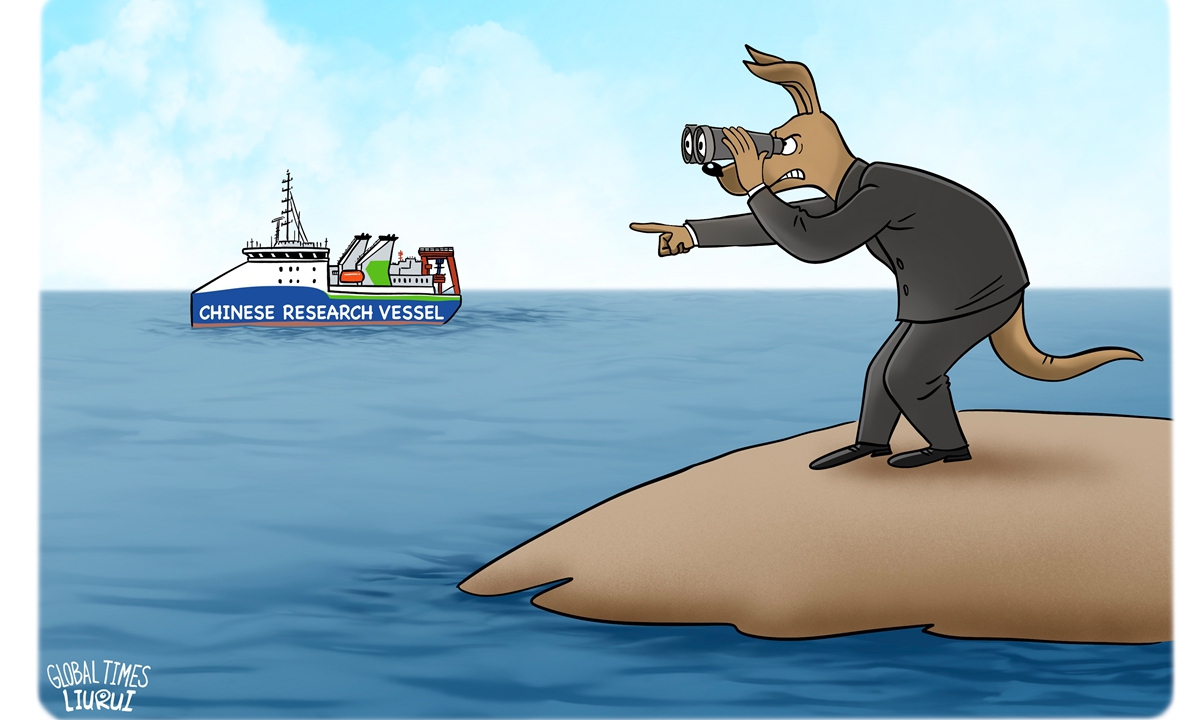
Illustration: Liu Rui/GTA new report funded by Australia's Department of Defense played up security risks to submarine cables in the Indo-Pacific waters and pointed finger at China and some other countries over alleged undersea‑cable attacks in recent years, while claiming threats against subsea cables are growing. A Chinese expert said that accusing China without conclusive evidence constitutes "over‑securitization" made by Australian side, as well as a calculated pretext for its own military expansion.
Published by the National Security College at the Australian National University (ANU), the paper claimed recent damage to cables in the Baltic Sea and around China's Taiwan region suggests "state actors are now actively probing and testing cable infrastructure in peacetime as part of broader hybrid warfare strategies" to rapidly degrade connectivity at the outset of a conflict, The Australian reported.
The paper claimed 16 privately owned subsea cables that carry 99 percent of Australia's internet traffic are a "high priority target" for Australia's adversaries that could be severed in a conflict, threatening the nation's economy and social fabric, according to The Australian.
The report singled out China and Russia for blame, saying that there have been multiple apparent attacks on submarine cables in recent years in European waters as well as near China's Taiwan region, suspected to be linked to Russia and China, the Straits Times reported.
However, the report cites a 2025 voyage by Chinese research vessel
Tan Suo Yi Hao along Australia's western and southern coastlines as evidence to back its claim that "potential adversaries are actively gathering information about Australia's cable infrastructure."
This report, relying on the routine scientific operations of a Chinese research vessel in 2025 to level allegations of offensive actions against China, and employing ambiguous terminology such as "suspected" and "potential," demonstrates Australia's evidentiary leap, Chen Hong, director of the Australian Studies Center of East China Normal University, told the Global Times on Monday.
This erroneous claim was refuted by the Chinese Foreign Ministry at the time. Chinese Foreign Ministry spokesperson Guo Jiakun said on March 31, 2025 that China carries out normal activities at sea in accordance with international law, including UNCLOS.
"We hope Australia will have a right understanding of this and stop the groundless suspicion and speculations," Guo added.
This is not the first time certain Australian politicians has leveled baseless accusations of China intending to sabotage its undersea cables. Back in May, Defense Minister Richard Marles claimed during the Shangri-La Dialogue that China ought to boost transparency around its maritime operations. He also asserted that a surge in damage to subsea cables had transformed the seabed into a "battlefield," per The Australian.
Chen said Australian side's scaremongering is tied to its predictive threat‑perception framework forged in recent years. This framework designates China and other countries as strategic competitors in advance, subsequently forces routine scientific activities into a confrontational framework, Chen said.
Apart from unfounded allegations against China, the paper claims Australia's defense military "must incorporate the defense of submarine cable infrastructure into its operational planning," according to The Australian.
It added the government should also consider up¬grading an auxiliary ship operated by the navy, ADV Guidance, to enable it to repair damaged cables.
The vast majority of submarine cable damages are caused by accidental factors such as fishing operations and vessel anchoring, rather than deliberate sabotage. For suspected cases of intentional damage, independent technical investigation bodies should be established, and the principle of "investigate first, characterize later" should be strictly applied, so as to prevent ordinary maritime accidents from escalating into diplomatic conflicts, Chen said.
The core problem of Australian side's submarine cable security lies entirely with itself. Instead of addressing its own infrastructure shortcomings and improving its domestic protection and maintenance systems, the Australian side has chosen to continually exaggerate external threats and stoke bloc confrontation, the expert added.
Chen said that by fabricating alleged Chinese threats, Australian side seeks to "rationalize" its military spending increases and underwater force expansion. The submarine digital infrastructure originally meant to serve global development has been labeled along us versus them lines, and this constitutes the biggest hidden danger, he added.
。
Current article:http://4b7mdr.aiwengchuanzuodahuai.shop/list_e02l/6ho.html
Published on:08:28:37